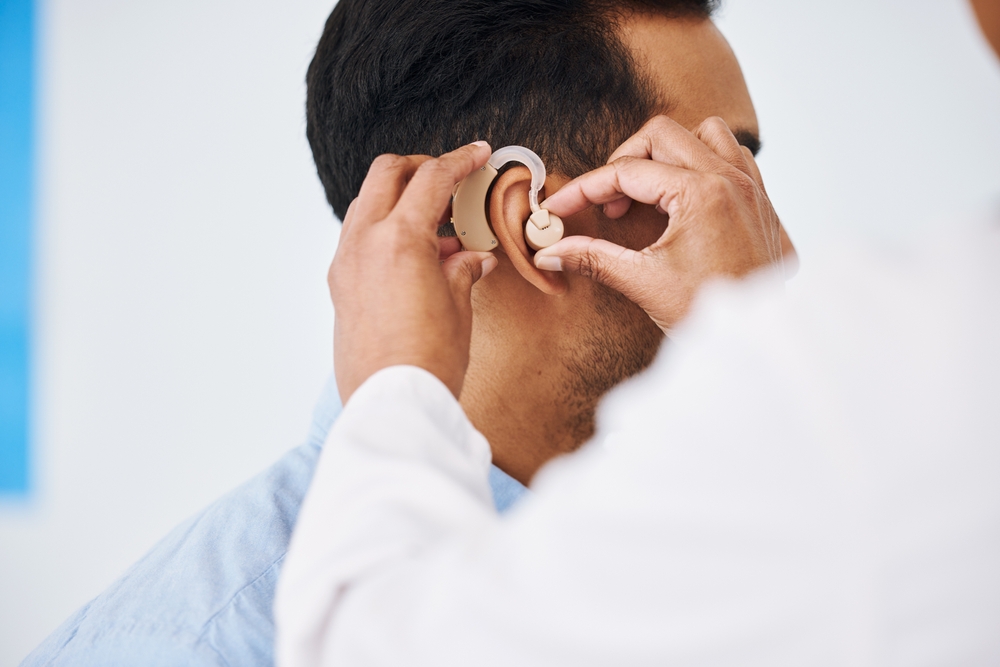
When most people think about hearing loss, they picture an issue rooted entirely inside the ear canal. It seems logical: your ears collect sound, so if you are struggling to follow a conversation, your ears must simply need a volume boost. For decades, traditional hearing aids operated on this exact assumption. They functioned essentially like tiny megaphones, grabbing all incoming sound and delivering it into the ear canals at a higher decibel levels.
But if you have ever used an older hearing aid in a crowded restaurant, you know exactly why that approach falls short. Clanging silverware, ambient music, and the chatter from three tables over all get amplified equally. The result isn’t clarity; it is an overwhelming wall of noise.
At Fairway Hearing Center, we focus on the complete picture of auditory health. Today, our team at Fairway Hearing Center is diving deep into the fascinating world of cognitive audiology to explain how modern hearing aids in Rehoboth Beach are no longer just amplifiers, they are sophisticated data processors designed to work in perfect harmony with your mind.
The Brain-Ear Connection: How We Actually Hear
To understand why modern hearing technology has shifted so radically, we have to look at the division of labor between your ears and your brain.
Your ears are essentially sensory collectors. Their job is to capture sound waves, convert them into electrical signals, and send those signals up the auditory nerve. However, those signals are just raw, unorganized data.
Your brain’s auditory cortex is where the real magic happens. It takes that raw data and immediately performs several complex cognitive tasks:
- Orienting: Scanning the environment to determine where different sounds are coming from.
- Separating: Distinguishing a friend’s voice from the hum of an air conditioner or background music.
- Focusing: Choosing which sound to prioritize while consciously ignoring irrelevant background noise.
When you develop hearing loss, the raw data traveling from your ears to your brain becomes degraded or filled with “gaps.” Your brain doesn’t just give up; instead, it works double-time to fill in those missing pieces.
This brings us to a concept our specialists at Fairway Hearing Center call cognitive overload. When your brain has to expend massive amounts of mental energy just to decode individual words, it has less processing power left over for memory, context, and spontaneous expression. This is why unaddressed hearing loss leaves people feeling completely exhausted after a simple family dinner or social gathering.
Enter BrainHearing™ Technology and Cognitive Processing
Modern hearing aids are engineered from the ground up to alleviate this cognitive burden. Instead of forcing your mind to do all the heavy lifting, the microscopic processors inside today’s devices act as a digital assistant to your brain’s natural processing style.
Rather than simply turning up the volume on everything, modern devices scan the environment thousands of times per second to map out a 360-degree sound landscape. They identify speech patterns, calculate the distance of background noises, and quickly organize the soundscape before it even reaches your eardrum.
By delivering a cleaner, more organized signal to the auditory cortex, these advanced devices reduce listening effort by up to 20% in complex environments. When your brain doesn’t have to strain to piece together broken syllables, social interactions become natural, relaxed, and enjoyable again.
How Modern Features Support Mental Clarity
This mind-first approach is powered by several cutting-edge features that the experts at Fairway Hearing Center customize for your daily life:
1. Spatial Sound Configuration
Your brain relies heavily on receiving sound at slightly different times in each ear to map out physical space. Modern hearing aids communicate with each other wirelessly across your head, preserving these natural interaural time differences. This allows you to effortlessly sense exactly who is speaking around a conference table or dinner layout.
2. Deep Neural Networks (DNN)
Some of the most advanced hearing aids available today are trained on millions of real-world sound scenes. Using embedded artificial intelligence, a Deep Neural Network can instantly recognize whether you are standing in a quiet living room, walking through a windy park, or sitting in a bustling café. It then automatically adjusts its parameters to mimic how a person with healthy hearing would naturally filter those specific sounds.
3. Speech Safeguard and Isolation
Instead of cutting off background noise entirely, which can make you feel isolated and disoriented, modern devices use precise directional microphones to isolate speech while keeping ambient sounds at a comfortable, non-intrusive level. This maintains your environmental awareness without sacrificing conversational clarity.
The Long-Term Stakes
Designing hearing aids that support the mind isn’t just about making conversations easier today; it is about protecting your long-term cognitive health.
Medical research over the last decade has revealed a profound link between untreated hearing loss and cognitive decline. Studies led by Johns Hopkins University found that mild, moderate, and severe untreated hearing loss can increase the risk of developing dementia by two, three, and five times, respectively.
There are two primary reasons for this connection:
- Auditory Deprivation: When the brain’s auditory center stops receiving regular stimulation due to hearing loss, those neural pathways can begin to atrophy from lack of use.
- Social Isolation: Because struggling to hear is exhausting and occasionally embarrassing, many individuals with hearing loss begin to withdraw from social situations. This lack of social and mental stimulation acts as a major accelerant for cognitive decline.
The great news is that proactive intervention makes a massive difference. Recent clinical trials have shown that treating hearing loss with modern, properly fitted hearing aids significantly slows the rate of cognitive decline in older adults who are at higher risk. By keeping your brain actively engaged with the world around you, you are quite literally exercising your mind.
What a Premium Fitting Looks Like at Fairway Hearing Center
Because modern hearing aids are essentially tiny, wearable supercomputers, they cannot simply be bought off a shelf and worn straight out of the box. To truly work with your mind, they must be made to work precisely with your unique auditory system and lifestyle.
As an independently owned and veteran-owned clinic, Fairway Hearing Center is not tied to any single manufacturer. This allows our specialists to recommend and precisely program the best technology from brands like Oticon, Phonak, Signia, and Resound based solely on what fits you best.
At Fairway Hearing Center, our fitting process looks at your lifestyle holistically. We measure:
- Your specific threshold of hearing across varied frequencies.
- Your ability to understand speech clearly when background noise is introduced.
- Your daily environments, whether you spend your time in quiet offices, out on the golf course, or at lively family gatherings.
Using this diagnostic data, we program the devices to seamlessly integrate with your brain’s natural listening style. We don’t just change how you hear the world; we change how your mind processes it.
If you or a loved one has noticed that following conversations feels more like a chore than a pleasure, it is time to give your brain the support it deserves. Contact Fairway Hearing Center today to schedule a diagnostic evaluation, and experience firsthand how modern technology can bring clarity back to your life.